1 Percent Rule vs Cash on Cash Return: What Each Screen Catches
1 percent rule vs cash on cash return: a 1 percent listing can still return 2% or 9%. See the same $500,000 rental screened both ways, with the math.
By the CashOnCashReturnCalculator.com team
1 percent rule vs cash on cash return comes down to what each one measures. The 1 percent rule asks whether monthly rent is at least 1% of the purchase price. Cash on cash return asks what is left after the mortgage and the operating costs, divided by the cash you put in.

A listing can pass the 1 percent rule and still return 2% or 9%, because the rule never sees your interest rate, your property tax bill or your insurance quote.
Both screens have a use. The trouble starts when a pass gets treated as proof the deal cash flows.
What the 1 percent rule and the 50 percent rule actually test
The 1 percent rule is a rent-to-price screen. Divide monthly rent by price, and pass it if the answer is 1% or more.
Said the other way, 1% a month means 100 months of rent to cover the price, which is a gross rent multiplier of 8.3.
The 50 percent rule is an expense screen. It assumes operating costs, including vacancy and repairs but not the mortgage, take about half of gross rent. Whatever is left has to cover debt service.
Neither rule has an official publisher. They are investor shortcuts that got repeated until they started to sound like standards.
What the two rules leave out
Price and rent are only two of the inputs. The rules say nothing about:
- Your interest rate and loan term
- Your down payment, closing costs and rehab spend
- The property tax rate in that county
- Insurance, which has moved sharply in coastal and wildfire markets
- HOA dues, management fees and capital reserves
Change any of those and the return moves while the rule result stays exactly the same. The line items that make up a rental’s operating costs are where most of the difference lives.
Does a 1 percent property hit a good cash on cash return?
Sometimes. The answer depends mostly on the mortgage rate. The standard example here rents for 1.04% of price each month, a clear pass, and returns about 6.3% on a loan at 7.25%. The same property financed at 5% returns 10.7%.
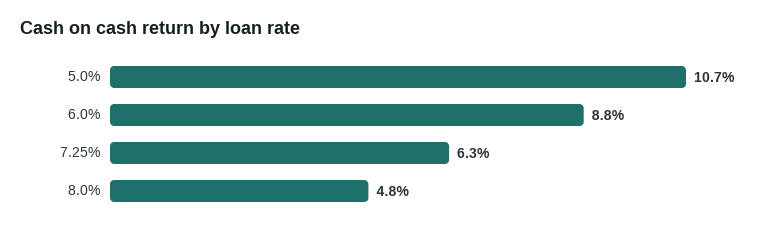
That example is a $500,000 rental renting for $5,200 a month, with $10,000 of rehab, $6,000 of property tax and $2,400 of insurance. With 25% down and $15,000 of closing costs, cash invested is $150,000 and net operating income is $40,210.
| Interest rate | Annual cash flow | Cash on cash |
|---|---|---|
| 5.0% | $16,053 | 10.7% |
| 6.0% | $13,230 | 8.8% |
| 7.25% | $9,512 | 6.3% |
| 8.0% | $7,190 | 4.8% |
So the 1 percent rule delivered the returns people associate with it when rates sat near 5 or 6%. Average 30-year rates are published weekly by Freddie Mac. At higher rates, the same screen passes properties in the mid single digits, which lands in the fair band rather than the good one. Whether you accept that is a separate question, and a 7% return is the usual place that argument starts.
The rule did not get worse. It never included the cost of debt, and debt is where most of the rent goes.
Where the rules break: high taxes, high rates, low prices
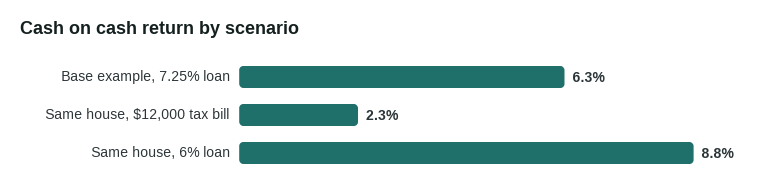
High property taxes break the 1 percent rule first. Keep the example identical and raise the tax bill from $6,000 to $12,000, an effective rate of 2.4% that parts of Texas, Illinois and New Jersey reach. Cash flow drops to $3,512 and the return falls to about 2.3%. The 1 percent result does not budge. The Census Bureau’s American Community Survey publishes median real estate taxes paid by county if you want to check a market before you tour it.
Low prices break the 50 percent rule. Fixed costs do not shrink with price. A $1,000 rent on a $100,000 house still faces a full insurance policy, a full turnover, and a roof that costs about what it costs on a $500,000 house. Cheap rentals often run 55 to 65% of gross rent in operating costs, so the 50 percent rule flatters them. The return at a $100,000 price is worth comparing against what the rule would predict.
The base example runs the other way. Its operating costs, vacancy included, come to roughly 36% of gross rent, not 50%. Applying the 50 percent rule would have predicted $31,200 of net operating income and about $500 of annual cash flow, a 0.3% return, and you would have passed on a property that actually returns 6.3%.
Using the rules to shortlist, cash on cash return to decide
A practical split:
- Screen the listing feed with the 1 percent rule. Anything under about 0.7% rarely works on a financed deal.
- Pull real numbers for whatever passes: the tax bill after reassessment, an insurance quote, HOA dues, a rate quote.
- Add the standard allowances for vacancy, management, maintenance and reserves, which the step by step formula lists.
- Add up total cash invested: down payment, closing costs, rehab and make-ready.
- Divide annual cash flow by cash invested and compare that against your hurdle.
If you already have both numbers, the simple tab handles it in one line: $12,000 of annual cash flow on $150,000 invested is 8%.
Set the hurdle before you start looking. The gap between 8% and a savings rate is your risk premium for owning something illiquid that can need a roof in any given year, and it helps to decide early how much monthly cash flow you need.
Three versions of the same 1 percent listing
| Version | 1 percent rule | Expenses vs 50 percent rule | Cash on cash |
|---|---|---|---|
| Base example, 7.25% loan | Pass at 1.04% | 36%, pass | 6.3% |
| Same house, $12,000 tax bill | Pass at 1.04% | 45%, pass | 2.3% |
| Same house, 6% loan | Pass at 1.04% | 36%, pass | 8.8% |
Same price, same rent, same two screens, three different deals. Only one of them clears an 8% hurdle.
Run the numbers on your own deal
Shortlist with the 1 percent rule if it saves you time on a listing feed. Decide with the Cash on Cash Return Calculator on the home page, where you can enter price, rent, rehab, taxes, insurance and loan terms and watch the return move as you change them.
Frequently asked questions
Is the 1 percent rule still useful at current mortgage rates?
It is useful for one job: throwing out listings fast. At a 7.25% loan, a property renting for 1.04% of price returns about 6.3% on the standard example here, not the 8 to 10% investors once expected from a 1 percent deal. Treat a pass as permission to underwrite the deal, not as evidence it cash flows.
What rent-to-price ratio does a 10% cash on cash return need?
Around 1.15% of price a month, holding everything else in the standard example steady. The $500,000 rental at $5,200 returns 6.3% with a 7.25% loan. Reaching 10% would take roughly $5,790 of rent, or a cheaper loan, or a larger down payment. Ratios that high are common in some Midwest and Southern markets and rare on the coasts.
Does the 50 percent rule include the mortgage payment?
No. The 50 percent rule covers operating expenses only: property tax, insurance, vacancy, repairs, management and reserves. The mortgage comes out of the other half of the rent. That is why a property can pass the rule and still produce almost nothing, because debt service at a high rate can swallow the entire remaining half.
Which is better for comparing two markets?
Cash on cash return. The 1 percent rule only sees rent and price, and the two costs that differ most between markets are the property tax rate and insurance. Two houses at the same price and rent can return 6.3% and 2.3% once a $6,000 tax bill becomes $12,000. Screen on rent-to-price, then price the real costs.