CapEx Reserves on a Rental Property: How Much to Set Aside Before You Trust the Return
CapEx reserves on a rental property are the line most returns skip. Size roofs, HVAC and turnovers from component life, then see the real number.
By the CashOnCashReturnCalculator.com team
CapEx reserves on a rental property are the dollars you set aside every year for big replacements: roof, HVAC, water heater, flooring, appliances. A practical range is 5 to 10% of the rent you actually collect, and the honest figure comes from pricing each major component and dividing by the years of life it has left.
Most quoted returns skip that line. Drop it from the standard example on this site and a 6.3% return reads as 8.3%.
If you want the inputs in order first, the cash on cash return formula walks through all six steps. This guide takes the step people leave out.
Why capital expenditures go missing from return math
Taxes, insurance and management arrive every year, so nobody forgets them. A roof arrives once in two or three decades.
Build a return from last year’s bank statements and capital costs look like zero, because last year they were zero.
Then the compressor dies in August and takes most of a year’s cash flow with it. The return was not wrong about the rent. It was wrong about timing. Operating expenses repeat on a schedule you can see. Capital costs come in lumps you have to predict.
A reserve turns the lump into a level annual charge, the way a sinking fund does for any known future bill.
CapEx or repair: which line does the cost belong to?
A repair keeps the property working the way it already did. A capital expenditure makes it better, restores it after it has worn out, or adapts it to a new use. Patching a leak is a repair. A new roof is capital.
Tax treatment follows the same split. Repairs come off this year’s income. Improvements get capitalized and written off over years, and the betterment, restoration and adaptation tests sit in the IRS tangible property regulations, with rental specifics in Publication 527. Accounting uses the same idea for every long lived asset, which capital spending covers in general terms.
Gray cases worth settling before you underwrite
Turnover make-ready is the usual argument. Paint and carpet between tenants is wear rather than improvement, but it is lumpy and tied to move outs instead of the calendar. Give it its own line or fold it into the reserve, then keep it there on every deal you price.
Appliances behave the same way. One dishwasher is small money and a full kitchen is not, so the cost acts like capital even when your accountant expenses it under a de minimis election.
A security deposit is not a cushion for either one. It answers for tenant damage and unpaid rent, and most of it usually goes back.
Sizing reserves from component life and replacement cost
- List the major components: roof, HVAC, water heater, windows, flooring, kitchen, baths, exterior paint, driveway, fence.
- Price each one with a local quote. Replacement cost swings hard by market and finish level, so a national average is worth little here.
- Estimate remaining life, not total life. A 20 year old roof on a 25 year product has 5 years left, not 25.
- Divide each cost by its remaining years.
- Add the annual amounts.
- Divide the total by collected rent to see what percentage you landed on.
Typical lives run roughly 20 to 30 years for an asphalt shingle roof, 15 to 20 for central HVAC, 10 to 15 for a tank water heater or a set of appliances, and 5 to 10 for carpet. Climate, water hardness and install quality move every one of those.
The $500,000 example with a reserve built from components
The site’s standard example is a $500,000 rental renting for $5,200 a month, with $10,000 of rehab, $6,000 of property tax and $2,400 of insurance. Cash invested is $150,000, net operating income is $40,210, annual cash flow is $9,512, and cash on cash return is about 6.3%. That math already carries a 5% reserve, which is $2,964 a year.
Now size the line from the house instead of from a percentage. Say local quotes come back like this:
| Component | Replacement | Years left | Per year |
|---|---|---|---|
| Roof | $14,000 | 25 | $560 |
| Central HVAC | $8,000 | 18 | $444 |
| Water heater | $1,800 | 12 | $150 |
| Appliances | $4,000 | 12 | $333 |
| Flooring | $7,000 | 12 | $583 |
| Interior paint and turnover | $3,000 | 4 | $750 |
| Exterior paint | $6,000 | 10 | $600 |
| Windows | $12,000 | 30 | $400 |
| Driveway, fence, other | $5,000 | 20 | $250 |
| Total | $4,070 |
That $4,070 is close to 7% of the $59,280 this property collects after vacancy. The 5% shortcut came in light by $1,106 a year.
Percentage of rent and per unit shortcuts, and where they fail
Two shortcuts dominate underwriting. The long-term rental rule of thumb is 5 to 10% of collected rent, low end for newer homes and high end for older ones. Apartment lenders often use a flat amount per unit per year instead, commonly in the $250 to $300 range and higher on older stock. Both are sanity checks, not answers.
The percentage breaks down when rent is high relative to building cost. A high rent condo with no roof, no exterior and no yard can over-reserve at 10%, because the HOA already collects for the shell.
It breaks the other way on cheap old houses. Five percent of $900 rent is $45 a month, and that will never replace a furnace.
Flat per unit amounts break on single family rentals, where one unit carries a whole roof, a whole HVAC system and a whole exterior.
How a reserve line changes cash on cash return
Same house, same rent, four reserve assumptions:
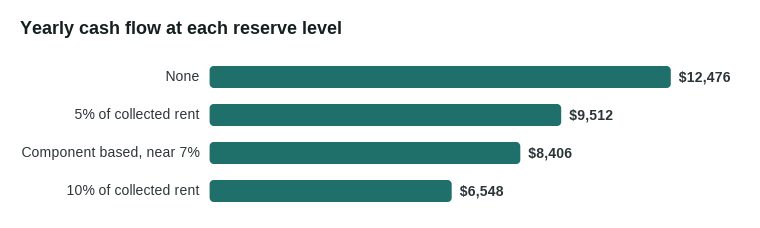
| Reserve | Annual amount | Cash flow | Cash on cash |
|---|---|---|---|
| None | $0 | $12,476 | 8.3% |
| 5% of collected rent | $2,964 | $9,512 | 6.3% |
| Component based, near 7% | $4,070 | $8,406 | 5.6% |
| 10% of collected rent | $5,928 | $6,548 | 4.4% |
Two full points separate the no-reserve row from the 5% row, and almost four points separate it from the 10% row. That is the gap between a deal you buy and one you pass on, and the building is identical in every row.
So keep the reserve inside the expense stack when you compare properties. How to calculate cash on cash return puts it in the same place each time, and the full rental expense list shows what else belongs beside it.
Older buildings, newer builds and reserve differences
New construction buys time, not freedom. Components start with full life and some carry warranty, so the early years run light. Nothing resets, though, so the roof you skipped reserving for still comes due on schedule.
Older buildings carry two costs at once: components near the end of life, and systems that are expensive because they are obsolete. Knob and tube wiring, cast iron drain lines, plaster walls and single pane windows all cost more to deal with than their modern equivalents. A sized reserve on a pre-war building can clear 10% of rent, and a seller’s spreadsheet almost never shows it.
Mid-century stock often sits in the worst spot. Too new to have been rebuilt, too old to have much life left in anything.
Put the reserve into the calculator
The cash on cash return calculator on the home page takes capital reserves as a percentage of collected rent, so you can enter your component based figure as its percentage and watch the return move. If you already know both totals, the simple tab takes them straight: $12,000 of annual cash flow on $150,000 invested is 8%.
Frequently asked questions
Should the capex reserve sit inside net operating income or below it?
Appraisers and lenders usually put a replacement reserve inside net operating income, which lowers both NOI and the cap rate you can claim. Brokers often leave it out so the cap rate looks better. Pick one treatment and use it on every deal you compare. If you place the reserve below NOI, label it clearly so you are not mixing two definitions.
Where should I keep the reserve money?
A separate savings account is the simplest answer, because money sitting in the operating account gets spent. Fund it monthly out of rent so the balance grows as components age, and start it partly funded if something major is near the end of its life. A line of credit can back it up, though a lender can cut that line when you need it most.
Can my security deposit count as a capex reserve?
No. The deposit belongs to the tenant until you have a documented claim against it, and many states require it to be held separately. It covers damage and unpaid rent, not a worn out roof. Counting it as a reserve double counts money you may have to hand back within weeks of a move out.
What if a major component fails before the reserve is funded?
Then you pay out of savings, a credit line or a refinance, and that year's return goes negative. That is the real risk of leaving the line out. Sizing a reserve does not stop a furnace from dying. It means the money is there when it does, and the return you underwrote already carried the cost.