Cash on Cash Return vs NOI: Why the Same NOI Pays Differently
Cash on cash return vs NOI: NOI is what the property earns before the loan, cash on cash is what your cash earns after it. One deal, both numbers, worked out.
By the CashOnCashReturnCalculator.com team
Cash on cash return vs NOI is the difference between two lines on the same deal: net operating income is what the property earns before the mortgage, and cash on cash return is what your own money earns after the mortgage is paid. Two rentals with identical NOI can pay out very different percentages, because NOI stops before the loan, before the closing costs and before the roof.
A listing quotes NOI because NOI belongs to the building. The return belongs to your deal.
Two different lines of the same deal
| Net operating income | Cash on cash return | |
|---|---|---|
| What it measures | The property | Your cash in the property |
| Formula | Collected rent − operating expenses | (NOI − debt service) / cash invested |
| Units | Dollars per year | A percentage |
| Includes the loan | No | Yes |
| Changes if you refinance | No | Yes |
Net operating income sits above the loan on the page. Everything about your financing happens below it.
Divide NOI by the purchase price and you get the Capitalization Rate, the yield the property would pay if you owned it outright. Wikipedia’s entry on capitalization rate has the formal version. Divide cash flow by your cash and you get the number your bank account actually sees.
What NOI includes and what it leaves out
NOI starts with gross rent, takes off vacancy, then takes off the cost of running the building: property tax, insurance, management, maintenance, reserves and any utilities you cover.

It leaves out four things that still cost you money.
- Mortgage principal and interest
- Capital expenditure such as a roof, a furnace or a parking lot
- Income taxes and depreciation
- Closing costs and the rehab you paid for before the first tenant moved in
Those four are why identical NOI pays differently. Note that the tax treatment is its own system: the IRS splits rental spending into deductible repairs and improvements you have to capitalize, as set out in Publication 527. NOI conventions and tax rules are not the same thing.
From rent to NOI on the standard example
The default example here is a $500,000 rental that rents for $5,200 a month, with $10,000 of rehab, $6,000 of property tax and $2,400 of insurance.
Gross rent is $62,400. Allow 5% for vacancy and you collect $59,280. Take off the tax and insurance, 8% for management and 10% for maintenance and reserves, and NOI is $40,210. That is a cap rate of about 8.0%.
Stop there and the property looks the same to every buyer. It is one number, and nothing about who buys it or how changes it.
How NOI turns into cash flow after debt service and CapEx
Put 25% down and the $375,000 loan at 7.25% over 30 years costs $30,698 a year. Subtract that from $40,210 and cash flow is $9,512.
Your cash invested is $150,000: a $125,000 down payment, about $15,000 of closing costs and $10,000 of rehab. So the return is $9,512 divided by $150,000, or 6.3%.
CapEx is the second gap. The 10% reserve in the NOI above is a smoothing estimate, not a bill. In the year you actually replace something, the money leaves your account. Spend $6,000 on a roof over and above the reserve and cash flow for that year drops to $3,512, a return of 2.3%. NOI does not flinch.
Worked example: same NOI, two very different returns
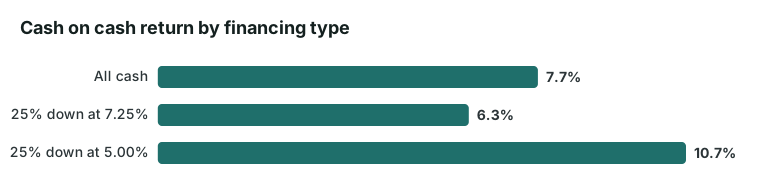
One property, $40,210 of NOI, three ways to pay for it.
| How it is financed | Debt service | Annual cash flow | Cash invested | Cash on cash |
|---|---|---|---|---|
| All cash | $0 | $40,210 | $525,000 | 7.7% |
| 25% down at 7.25% | $30,698 | $9,512 | $150,000 | 6.3% |
| 25% down at 5.00% | $24,157 | $16,053 | $150,000 | 10.7% |
The spread from 6.3% to 10.7% comes entirely from the rate. Whether borrowing helps depends on the loan’s annual cost against the cap rate, which the guide on cap rate against your own return works through in detail.
So when a broker says two listings both produce $40,000 of NOI, that tells you the buildings earn alike. It says nothing about what either one would pay you.
Net cash on cash return: what the word net adds
In almost everything you will read, net cash on cash return means plain cash on cash return. Net is there to say the numerator is net of everything: net of operating expenses, net of the mortgage payment.
Some sponsors use gross cash on cash for the figure before debt service. On the example above that would be $40,210 on $150,000, a meaningless 26.8%, since the loan that bought most of the building is nowhere in it.
When a document shows a net figure, check two things. Is debt service subtracted? And is the denominator all of your cash, or only the down payment? Dropping the rehab and closing costs from the $150,000 lifts the same deal from 6.3% to 7.6% without a dollar changing hands.
The cash on cash return ratio next to ROI, ROE and IRR
Cash on cash return ratio is the same measure in ratio form: $9,512 on $150,000 is 0.063 to 1. The formatting changes, the math does not.
It is a one year, cash only measure, which is what makes it useful and what limits it. Return on Investment (ROI) can fold in appreciation and loan paydown. Return on Equity (ROE) divides by your equity today rather than what you first put in, so it falls as equity grows. Internal Rate of Return (IRR) adds timing and the eventual sale.
NOI feeds all of them. It is never the answer to any of them.
When to quote NOI and when to quote the return
Quote NOI when you are talking about the property: comparing two buildings, testing an asking price, arguing with an appraiser, or checking whether the pro forma left out management and reserves. NOI is also the language commercial lenders speak.
Quote the return when you are talking about your money: choosing between 20% down and 25%, deciding whether a rate buydown is worth it, or asking whether this $150,000 is better off in a rental than somewhere else.
One quick test. If a number changes when you change the loan, it is a return, not NOI.
Run both numbers on your own deal
The free Cash on Cash Return Calculator on the home page takes you from rent and expenses down to NOI, then down again through debt service to the return. The detailed tab runs the $500,000 example above. The simple tab takes the two numbers you already have, so $12,000 of annual cash flow on $150,000 invested returns 8%.
Frequently asked questions
What is the difference between cash on cash return and NOI?
Net operating income is a dollar figure: collected rent minus operating expenses, before the mortgage. Cash on cash return is a percentage: cash flow after the mortgage divided by the cash you put in. NOI describes the property, so it does not move when you change the loan. Cash on cash describes your position, so it moves every time the financing changes.
What does net cash on cash return mean?
Net cash on cash return usually means plain cash on cash return, with the word net signaling that the top of the fraction is net of everything that leaves your account: operating expenses and the mortgage payment. Some documents use gross cash on cash for the figure before debt service. When you see a net number, check that debt service is subtracted and that the denominator is total cash invested, not just the down payment.
Is cash on cash return a ratio or a percentage?
Both wordings describe the same measure. The cash on cash return ratio is just the unformatted version. Annual cash flow of $9,512 on $150,000 invested is 0.063 to 1, which is 6.3%. The ratio phrasing turns up in lender and appraisal paperwork, where other ratios such as debt service coverage are quoted the same way.
Can two properties with the same NOI have different cash on cash returns?
Yes, and it happens constantly. Take the standard $500,000 rental with $40,210 of NOI. Bought all cash, with $525,000 in the deal, it returns 7.7%. With 25% down at 7.25%, the loan costs $30,698 a year, leaving $9,512 on $150,000 invested, or 6.3%. At 5%, the same property returns 10.7%. The NOI never moved.