How to Estimate Market Rent for a Rental Property Before You Calculate the Return
Learn how to estimate market rent from signed leases, not asking prices, and see how a $100 rent error moves cash on cash return on a $500,000 rental.
By the CashOnCashReturnCalculator.com team
How to estimate market rent: find five to ten similar units near the property that signed a lease in the last three to six months, adjust each one for bedrooms, size, condition and parking, then take the middle of that adjusted range as your monthly rent. Signed leases beat asking prices, because an asking price is only what one landlord hoped to get.
Rent is the top line of every rental deal. If it is wrong, nothing underneath it holds, including the cash on cash return formula and every expense you priced out carefully. If the measure itself is new, read what cash on cash return measures first, then come back and build the rent number properly.
Why Rent Is the Most Expensive Assumption to Get Wrong
Most costs on a rental are knowable before you close. Property tax comes from the county, insurance from a written quote, debt service from the loan terms.
Rent is the one line you forecast.
It also multiplies. Rent sets gross scheduled income, and the standard allowances for vacancy, maintenance, capital reserves and management are all percentages of collected rent. One rent number moves five lines at once.
How to Estimate Market Rent From Comparable Rentals
Work in this order.
- Draw a tight circle. Same neighborhood, same school zone, same side of the main road. A mile can hold two different rental markets.
- Match the unit type. House to house, three bed to three bed, in-unit laundry to in-unit laundry.
- Keep recent leases only. Three months is ideal, six is the outside limit.
- Drop the extremes. The fresh renovation and the unit with a dead furnace both lie to you.
- Adjust what is left for the differences you could not match.
- Take the median of the adjusted comps rather than the average, since one outlier cannot drag a median.
Five clean comps beat twenty loose ones.
Where to find rental comps
- Local property managers. They know signed rents and how long each unit sat empty. Many will share numbers for free because they want the management contract.
- The rental section of the MLS, which records the leased date and the final lease price instead of only the ask.
- Leases in the seller’s file when the property is tenant occupied. Ask for the leases themselves, not a summary sheet.
- HUD Fair Market Rents, published each year by metro area and county for the housing voucher program.
What you are solving for is the property’s rental value, the rent a willing tenant would pay a willing landlord with both sides informed and neither one forced. Appraisers reach it by comparing similar rented properties, which is the same method you are running on a smaller scale.
Checking Listing Prices Against Signed Leases
An active listing is an offer. A signed lease is a price.
Three gaps show up between the two.
- Time on market. A unit asking $5,400 that sits for 70 days was not priced at market.
- Concessions. One free month on a 12 month lease at $5,200 is an effective rent of $4,767.
- Quiet reductions. Check whether the ask dropped before anyone signed.
Underwrite the money that lands in the account, not the headline on the listing.
Adjusting for Condition, Bedrooms, Square Footage, and Parking
| What differs | How to adjust | Where the number comes from |
|---|---|---|
| Bedroom count | Compare within the same count wherever you can | The spread between counts in your own comp set |
| Square footage | Rent per square foot, inside one bedroom count | Your comps, never a citywide average |
| Condition | Price the gap between the updated and dated comps | The two ends of your own set |
| Parking | Add the monthly rate a nearby garage or lot charges | Local parking prices |
| Utilities included | Subtract the owner-paid utility cost | The actual bills |
| Pets, yard, laundry | Small premiums, a few percent at most | Comps that differ on only that feature |
Every adjustment should come from your own comp set. A percentage you read somewhere is not evidence about this block.
Gross Rent, Effective Rent, and Other Income
Monthly rent times twelve is gross scheduled income. Subtract vacancy and credit loss and you have effective gross income, the money you expect to collect. Subtract operating expenses and you have net operating income.
Other income belongs in the top line too: parking, storage, laundry, pet rent and utility reimbursements. Count it only when you can name the price and point to the demand.
A security deposit is not income. You hold it for the tenant, and in most states it goes back when they leave.
How a $100 Rent Error Moves Cash on Cash Return
Take the standard example: a $500,000 rental renting for $5,200 a month, with $10,000 of rehab, $6,000 of property tax and $2,400 of insurance. With 25% down and $15,000 of closing costs, cash invested is $150,000. The $375,000 loan at 7.25% over 30 years costs $30,698 a year. Net operating income is $40,210, annual cash flow is $9,512, and cash on cash return is about 6.3%.
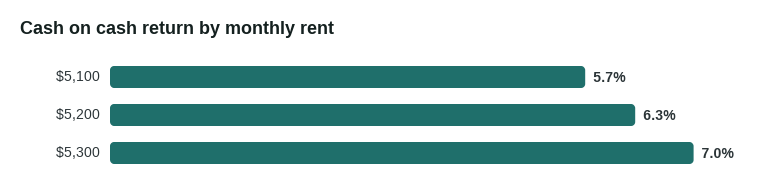
Now move rent by $100 a month and change nothing else.
| Monthly rent | Annual cash flow | Cash on cash return |
|---|---|---|
| $5,100 | $8,577 | 5.7% |
| $5,200 | $9,512 | 6.3% |
| $5,300 | $10,446 | 7.0% |
That $1,200 of gross rent does not arrive as $1,200 of cash flow. Vacancy takes 5%, and the percentage allowances take 18% of what is collected, so about $935 reaches the bottom line. On $150,000 invested, that is 0.6 of a point per $100 of rent.
Read it the other way and it stings more. A rent estimate 5% too high, about $5,460 here, shows roughly 7.9% on a property that delivers 6.3%. That is the difference between a deal you chase and a deal you pass on, created by one line you guessed at. If the mechanics are fuzzy, the steps behind that 6.3% run through each one.
Run Your Rent Estimate Through the Calculator
The Cash on Cash Return Calculator on the home page takes rent, vacancy, expenses and loan terms and shows every line between them. The simple tab is faster when you already know the totals: $12,000 of annual cash flow on $150,000 invested is 8%.
Run your estimate twice, once at the comps and once $100 below them. A deal that only works at the top of the rent range is a deal that needs your forecast to be perfect.
Frequently asked questions
What rent should I use if the property already has a tenant?
Use the lease in place, because that is the cash you will actually collect. Then price market rent separately so you can see the gap. A unit renting $300 under market is upside only if you can raise it, which depends on the lease end date, local notice rules and any rent regulation. Underwrite the current rent first.
Can I use HUD Fair Market Rent as my rent assumption?
No. Fair Market Rent is a payment standard for housing vouchers, generally set near the 40th percentile of local rents for standard quality units. It works as a sanity check and as a floor for a modest unit, but it understates rent on a renovated or well located property. Signed leases from comparable units are the better basis.
Should I build annual rent increases into the calculation?
Not for this measure. Cash on cash return covers a single year, so it takes one year of rent and one year of expenses. Put rent growth in a multi year projection instead, where internal rate of return or discounted cash flow can carry it. Folding growth into a one year figure makes the first year look stronger than it will be.
How far away can a rental comp be and still count?
Closer than most investors assume. Rent follows neighborhood lines, school zones and walkability, so a comp half a mile away across a highway can sit in a different market. Start within half a mile and the same unit type. Widen only if you have fewer than five recent leases, and note each time you stretch so you can discount the answer.