After Tax Cash on Cash Return: How Depreciation and Your Tax Bracket Change the Number
The standard cash on cash return is pre-tax. Here is how to work out after tax cash on cash return, with depreciation and your bracket in the math.
By the CashOnCashReturnCalculator.com team
After tax cash on cash return is the annual cash a rental leaves you once income tax is settled, divided by the cash you invested. The standard formula is pre-tax, and depreciation often pushes the after tax figure above the pre-tax one instead of below it.
That catches people out. Tax usually takes a bite. Here it can hand money back, because a property’s taxable income and its cash flow are two different numbers built from the same rent.
If the basic measure is new to you, start with what cash on cash return measures and come back.
Is cash on cash return pre-tax or after-tax?
Pre-tax. Every standard definition, and every figure a lender, broker or equity partner quotes, uses cash flow before income tax.
That is deliberate. Tax belongs to the investor, not the building. Two buyers of the same duplex owe different amounts on the same rent, so a pre-tax number keeps deals comparable. It is also one of the limitations of cash on cash return worth understanding.
How depreciation separates taxable income from cash flow
Depreciation is a deduction you take without spending anything. The IRS treats a residential rental building as wearing out over 27.5 years, so you write off part of the building’s cost every year. Land is never depreciated.

Under MACRS, residential rental property uses that 27.5 year life with a mid month convention, so the first year is prorated from the month the property is placed in service. IRS Publication 527 walks through the rules.
Two more lines split off from the cash math. Only the interest part of a mortgage payment is a tax deduction, while principal is not. And cash moved into a reserve is not deductible until it is spent, with improvements capitalized and depreciated rather than expensed.
Working out after tax cash flow step by step
- Start with net operating income.
- Subtract mortgage interest for the year, not the whole payment.
- Subtract annual depreciation on the building.
- The result is taxable income, or a taxable loss.
- Multiply it by your marginal rate to get tax owed, or tax saved on a loss.
- Take that tax off pre-tax cash flow, or add the saving back.
- Divide by cash invested.
The standard example, run through the tax lines
The site’s example is a $500,000 rental that rents for $5,200 a month, with $10,000 of rehab, $6,000 of property tax and $2,400 of insurance. With 25% down and $15,000 of closing costs, cash invested is $150,000. Net operating income is $40,210, the $375,000 loan at 7.25% over 30 years costs $30,698 a year, and cash flow is $9,512. Pre-tax cash on cash is about 6.3%.
Now the tax lines. About $3,630 of the first year’s payments goes to principal, so interest is close to $27,068. If the assessor puts land at 20% of value, building basis is $400,000 and depreciation is $14,545 a year.
$40,210 less $27,068 of interest less $14,545 of depreciation is a taxable loss of $1,403. The property paid you $9,512 in cash and reported a loss on paper.
At a 24% marginal rate, that loss saves $337, so after tax cash flow is $9,849 and after tax cash on cash return is about 6.6%.
One honest caveat. The 18% of rent set aside here for maintenance, reserves and management is not all deductible in the year it is reserved, so a real return could show taxable income a few thousand dollars higher. The land share also swings by market, commonly 15% to 30% of value, and the figure to use is your own assessor’s split or an appraisal.
Why two investors get different after-tax returns on the same property
Same house, same rent, same loan, different tax outcomes.
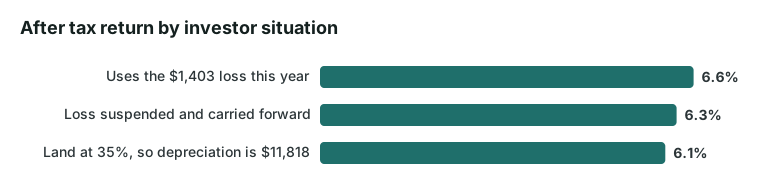
| Investor situation | Marginal rate | Tax effect | After tax cash flow | After tax return |
|---|---|---|---|---|
| Uses the $1,403 loss this year | 24% | $337 saved | $9,849 | 6.6% |
| Loss suspended and carried forward | 35% | None this year | $9,512 | 6.3% |
| Land at 35%, so depreciation is $11,818 | 24% | $318 owed | $9,194 | 6.1% |
Rental losses are passive. They offset passive income first. Active participation lets you take up to $25,000 of loss against other income, and that allowance phases out between $100,000 and $150,000 of modified adjusted gross income, which the IRS sets out in its guide to passive activity losses. Losses you cannot use are suspended and carry forward.
So a high earner can collect passive income and still see no tax benefit this year. The deduction is not lost, only delayed.
Depreciation recapture sits outside this number
Depreciation lowers your cost basis, which raises the gain when you sell. The slice of gain created by depreciation you took is unrecaptured Section 1250 gain, taxed at a maximum 25% rate, above the long term capital gains tax rate most sellers pay on the rest.
Five years of $14,545 is $72,725 of basis reduction, up to roughly $18,181 of tax at that top rate.
That is a sale event, not an annual one, so it has no place in an annual yield. Count depreciation recapture in a hold period measure such as IRR or total return, and note that a 1031 exchange can defer it.
When the pre-tax number is the right one to use
Use the pre-tax figure for screening, for talking to lenders and partners, and for comparing one deal against another. It is the common language.
Switch to after tax when you weigh a rental against a taxable alternative, and compare after tax to after tax on both sides. On the simple tab, $12,000 of annual cash flow on $150,000 invested is 8%. If interest and depreciation leave $2,000 of taxable income, a 24% bracket owes $480, so after tax cash flow is $11,520 and the after tax return is 7.7%.
Remember that the tax picture moves. Brackets change, your income changes, and depreciation ends after 27.5 years while the rent keeps coming.
Run the numbers on your own deal
Put your own price, rent, loan and costs into the cash on cash return calculator on the home page to get the pre-tax figure, then run the three tax lines above on top of it.
Frequently asked questions
Is after tax cash on cash return usually higher or lower than the pre-tax figure?
Often higher. Depreciation is a deduction you do not pay for in cash, so taxable income can land below cash flow or even show a loss. In the standard example, $9,512 of cash flow comes with a $1,403 paper loss. If you can use that loss, tax hands back $337 and the return moves from 6.3% to about 6.6%.
Can I deduct a rental loss against my salary?
Rental losses are passive, so they offset passive income first. If you actively participate, up to $25,000 of loss can offset other income, and that allowance phases out between $100,000 and $150,000 of modified adjusted gross income. Anything you cannot use is suspended and carries forward, usually freeing up when you sell.
Should I use my marginal rate or my effective rate?
Marginal. You are asking what happens to the next dollar the property earns or shelters, so the rate on that dollar is the one that counts. Add state income tax if your state charges it. An effective rate averages all your income, so it understates both the tax on rental profit and the saving on a loss.
How does a cost segregation study change the number?
A cost segregation study splits the building into components with shorter depreciation lives, so more of the write-off lands in the early years. That lifts the after tax return now and lowers it later, because total depreciation does not change. The study costs money, and the extra deductions still face recapture at sale.