Mortgage Constant Formula: Annual Debt Service by Rate and Term
The mortgage constant formula turns a rate and a term into annual debt service. Use the table at 15, 20 and 30 years to check cash on cash return fast.
By the CashOnCashReturnCalculator.com team
The mortgage constant formula is annual debt service divided by the original loan amount. On a $375,000 loan at 7.25% over 30 years the payments total $30,698 a year, so the mortgage constant is 8.19%.
That number bridges the gap between a rate a lender quotes and the dollar figure the cash on cash return formula actually needs. The formula wants annual debt service. A loan officer gives you a rate and a term. The constant turns one into the other with a single multiplication.
The mortgage constant definition explains the term. This page gives you the table, the arithmetic and the three loan types where the shortcut lies to you.
What Is a Mortgage Constant?
A mortgage constant is the percentage of the original loan balance you pay out each year in principal and interest combined. Lenders and appraisers also call it the loan constant.
It is always higher than the interest rate on a loan that amortizes. The payment covers interest plus a slice of principal, and only the interest part tracks the rate.
That gap widens as the term shortens. A 15 year loan clears the balance in half the time of a 30 year loan, so much more of every payment is principal rather than cost.
Mortgage Constant Formula: Annual Payment Divided by Loan Amount
Mortgage constant = annual debt service / original loan amount
Twelve payments of $2,558 come to $30,698. Divide that by the $375,000 loan and you get 0.0819, or 8.19%.
Building the Constant From Just a Rate and a Term
With no payment quote in hand, the constant falls out of the standard payment math:
monthly factor = i / (1 - (1 + i)^-n)
Here i is the annual rate divided by 12, and n is the number of monthly payments, so 180 for a 15 year loan and 360 for a 30 year loan. Multiply the monthly factor by 12 to get the annual constant. Wikipedia’s amortization calculator page sets out the same equation.
Mortgage Constant Table: Common Rates at 15, 20, and 30 Years
Every figure below is annual principal and interest as a percentage of the starting loan balance. Fixed rate, monthly payments, taxes and insurance excluded.
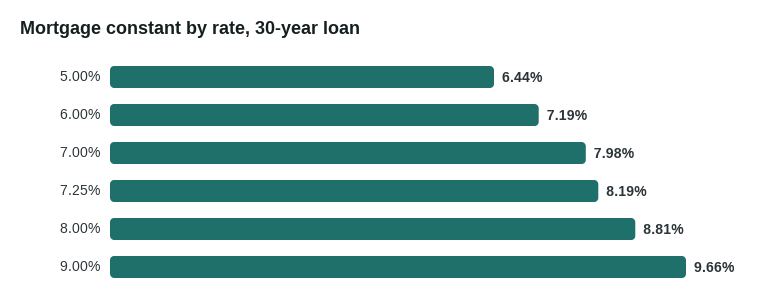
| Rate | 15 years | 20 years | 30 years |
|---|---|---|---|
| 5.00% | 9.49% | 7.92% | 6.44% |
| 6.00% | 10.13% | 8.60% | 7.19% |
| 7.00% | 10.79% | 9.30% | 7.98% |
| 7.25% | 10.96% | 9.48% | 8.19% |
| 8.00% | 11.47% | 10.04% | 8.81% |
| 9.00% | 12.17% | 10.80% | 9.66% |
The rate you are quoted moves with the market and with your credit, loan size and whether you will occupy the property. The table runs from 5% to 9% to cover the usual spread of investor quotes. If your rate sits outside it, use the formula above.
How to Turn the Constant Into Annual Debt Service
- Find your rate and term in the table and read off the constant.
- Multiply the loan amount by the constant. That is annual debt service.
- Subtract it from net operating income to get annual cash flow.
- Divide cash flow by total cash invested.
Run the site’s standard example. A $500,000 rental rents for $5,200 a month, with $10,000 of rehab, $6,000 of property tax and $2,400 of insurance. Net operating income is $40,210 once vacancy, maintenance, reserves and management are out.
Step two gives $375,000 at 8.19%, or $30,713. The exact payment schedule says $30,698, so rounding the constant to two decimals costs about $15 on a $30,000 line.
Cash flow is $9,512. Cash invested is $150,000: the $125,000 down payment, $15,000 of closing costs and the $10,000 of rehab. Cash on cash return is 6.3%.
The Same Loan Over 15 Years
Hold every other number and shorten the term. The constant climbs from 8.19% to 10.96%, so debt service becomes $41,091 a year.
That is more than the property’s entire net operating income. Cash flow is negative $881 and the return is about -0.6%, even though the house, the rent and the loan balance never changed.
Checking Cash on Cash Return Without an Amortization Schedule
An amortization schedule splits every payment into interest and principal, month by month. You need that split at tax time. You do not need it here.
Cash on cash return treats principal and interest the same way, because both leave your bank account. One constant and one multiplication replace the whole schedule. The short version of the math sits on how do I calculate cash-on-cash return.
When you already know your cash flow, skip the loan math entirely. On the simple tab, $12,000 of annual cash flow on $150,000 invested is 8%.
Comparing the Constant to the Cap Rate
This is the part a plain definition leaves out. Set the mortgage constant beside the property’s cap rate.

The standard example has a cap rate of 8.0%, since $40,210 of net operating income on a $500,000 price. The constant is 8.19%. You are paying 8.19% a year on borrowed money to hold an asset yielding 8.0%, so each borrowed dollar costs a little more than it earns.
That is negative leverage, and it explains why the all cash version of this deal returns 7.7% while the financed version returns 6.3%. The guide on cash on cash return and leverage works through both directions.
A constant below the cap rate means the debt is adding to your return. Equal means the loan is roughly neutral.
Where the Constant Misleads: Interest-Only Loans, ARMs, and Balloons
On an interest-only loan the constant equals the interest rate, because no principal is due yet. The same $375,000 at 7.25% interest only costs $27,188 a year, cash flow rises to $13,022 and the return reads 8.7%. That figure expires the month the interest-only period ends.
On an adjustable-rate mortgage the constant holds only until the first reset. Rerun it at the rate cap to see the bad case before you buy.
A balloon loan hides a larger problem. Payments may be set on a 30 year schedule while the full balance comes due in five or seven years, and the constant says nothing about where that payoff comes from.
Two smaller cautions. The constant is measured against the original loan amount, so it does not describe your position years later. And it leaves out escrowed taxes and insurance, mortgage insurance and points, all of which still take cash.
Run Your Own Loan
Pick a rate and term, multiply, subtract, divide. If you would rather not do it by hand, the Cash on Cash Return Calculator on the home page builds debt service from your rate and term, shows every line, and moves the return as you change either one.
Frequently asked questions
Is the mortgage constant the same thing as the interest rate?
Not on a loan that amortizes. The rate prices the money. The constant measures the whole payment, principal included, so it is always the larger number. At 7.25% over 30 years the rate is 7.25% and the constant is 8.19%. The two match only on an interest-only loan, where the payment is pure interest.
Does the mortgage constant change as I pay the loan down?
The constant itself does not. It is fixed by the rate and the term, and it is measured against the original loan amount. On a fixed rate loan the payment does not move either. What drifts is the ratio of that payment to the current balance, which climbs as the balance falls. Cash on cash return uses the original figure.
Can I use the mortgage constant to size a loan from a lender's coverage test?
Yes, and it takes two steps. Divide net operating income by the required debt service coverage ratio to get the largest annual payment the lender will allow, then divide that payment by the constant to get the loan. With $40,210 of net operating income, a 1.25 ratio and an 8.19% constant, the loan tops out near $393,000.
Should I compare loans by APR or by the mortgage constant?
They answer different questions. APR folds loan fees into a single rate so you can rank offers from different lenders. The mortgage constant converts a loan into the dollars that leave your account each year, with fees excluded. Use APR to choose the lender, then use the constant to build debt service and cash flow.
Is a lower mortgage constant always better?
A lower constant means less cash out the door each year, but it usually comes from a longer term, which means more total interest and slower equity build. The same loan carries an 8.19% constant over 30 years and 10.96% over 15. The long version pays you more today. The short version owns the house far sooner.