Vacancy Rate for a Rental Property: What Percentage to Budget
The vacancy rate for a rental property is usually 5%. See where to find your market's rate, when to budget 8 to 10%, and what each point costs your return.
By the CashOnCashReturnCalculator.com team
The vacancy rate for a rental property is the share of the year the unit sits empty, written as a percentage of the rent it would collect if it stayed full. For a long term single family rental in a stable market, budget 5%, which is about 18 days of empty time a year.

That number is the first subtraction in the cash on cash return formula. Get it wrong and every figure downstream is wrong with it.
Where vacancy enters the return calculation
Start with gross scheduled income: monthly rent times twelve, plus parking, laundry, storage and pet rent. That is what the property collects if nobody ever moves out.
Subtract the vacancy allowance. What is left is effective gross income, the rent you actually expect to bank.
From there you subtract operating expenses to reach net operating income, subtract the mortgage payment to reach annual cash flow, then divide by total cash invested. The short version of that sequence sits on how do I calculate cash on cash return.
One detail trips people up. Management and maintenance are usually quoted as a percentage of collected rent, not scheduled rent. Raise your vacancy assumption and those line items shrink a little, which softens the hit.
Credit loss belongs here too. A tenant who stays but stops paying costs you the same rent as an empty unit, so most underwriting folds both into a single vacancy and credit loss line.
How to find the vacancy rate for your market
Three sources, from most useful to least.
- Active listings. Count comparable rentals advertised in your zip code and check how long they have been sitting. Two weeks on market is tight. Two months is not.
- Property managers. Call three local firms and ask what days on market and annual turnover they see for your unit type. They track it for a living and will usually tell you for nothing.
- Public data. The Census Bureau reports rental vacancy rates by region and by metro in its Housing Vacancies and Homeownership survey.
Treat public figures as a sanity check rather than an input. They average whole metros and every unit type, so one well located house in a good school zone usually does better than the headline number. It helps to remember what the measure actually is: a vacancy rate counts unoccupied units across a pool of housing, not the track record of your address.
What percentage to budget on a long term single family rental
Use 5% as the default for a house in decent shape, in a stable market, priced at market rent.
Push it to 8 to 10% when any of these apply:
- Rent sits at the lower end of the market and tenants move often.
- The property is student housing with one fixed turn date a year.
- The submarket is absorbing a wave of new apartments.
- The unit needs work before it will show well.
Go under 5% only with evidence. A tenant two renewals deep, or a manager quoting single digit days on market, can support 4%. Below that you are betting on a perfect decade. A vacancy line of zero is not optimism, it is a missing input.
Turnover cost is not the same thing as vacancy
Vacancy is rent you never collect. Turnover cost is money you spend to make the unit rentable again: paint, cleaning, carpet, new locks, a leasing fee to the manager.
The two move together and they still need separate lines. A single turn in a $5,200 a month house can mean one empty month plus $2,000 of make ready work, and only the first half of that shows up in your vacancy percentage.
Put small make ready work in maintenance. Put anything with a long life, like flooring or an HVAC unit, under capital expenditure and fund it from reserves. A security deposit offsets tenant damage, not ordinary wear, so do not count on it to pay for a turn.
Short term rentals use occupancy, not a vacancy allowance
Nightly rentals do not get a 5% haircut. They get an occupancy rate, and it drives revenue instead of nudging it.
A lake house booked 65% of nights is doing well. The other 35% is not a problem to fix, it is the shape of the business, and seasonality decides most of it. Platform fees and cleaning then come out of what you do book. Cash on cash return on a short term rental runs the full version.
Worked example: how a 5% vacancy assumption moves the return
The standard example on this site is a $500,000 rental that rents for $5,200 a month, with $10,000 of rehab, $6,000 of property tax and $2,400 of insurance. With 25% down and $15,000 of closing costs, cash invested is $150,000. Maintenance, reserves and management run 18% of collected rent, and the $375,000 loan at 7.25% over 30 years costs $30,698 a year.
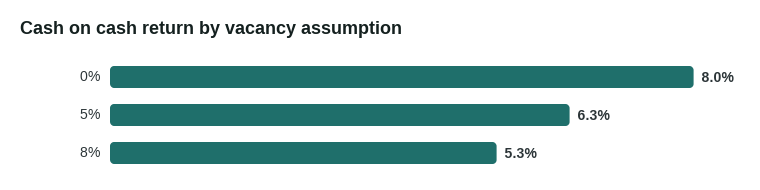
| Vacancy assumption | Collected rent | Net operating income | Annual cash flow | Cash on cash return |
|---|---|---|---|---|
| 0% | $62,400 | $42,768 | $12,070 | 8.0% |
| 5% | $59,280 | $40,210 | $9,512 | 6.3% |
| 8% | $57,408 | $38,675 | $7,977 | 5.3% |
Leave vacancy out and the property reads as 8.0%. Budget 5% and the honest answer is 6.3%. Assume a harder market at 8% and you are down to 5.3%.
What one point of vacancy is worth
Each point costs $624 of rent on this property. After the percentage based expenses adjust, that is roughly $512 of cash flow, or about a third of a point of return. So three points of sloppy guessing moves the headline number by a full point.
The simple tab behaves the same way. Enter $12,000 of annual cash flow on $150,000 invested and you get 8%, but that cash flow has to be net of vacancy before you type it in. No calculator can tell whether you took it out.
Run your own numbers
Set your vacancy percentage, then let the Cash on Cash Return calculator on the home page carry it through gross rent, operating expenses, debt service and the final return.
Frequently asked questions
Does the vacancy allowance come out before or after operating expenses?
Before. Subtract vacancy from gross scheduled rent first, which gives effective gross income, then take operating expenses off that figure. Doing it in the other order inflates net operating income, because percentage based costs like management and maintenance get charged against rent you never collected. The standard example moves from $62,400 of scheduled rent to $59,280 collected at 5%.
Do I still need a vacancy line if a tenant is already in place at closing?
Yes. You are budgeting for a year of ownership, not for closing day. The sitting tenant will eventually give notice, and the gap between that move out and the next signed lease is the cost you are reserving for. An inherited lease with a strong payment history can justify 4% instead of 5%, but not zero.
How many days of empty time does a 5% vacancy rate represent?
About 18 days a year, or 2.6 weeks. On a house renting for $5,200 a month, that is $3,120 of rent you plan not to collect. One turn with three weeks of downtime uses the whole allowance, which is why 5% is a floor for most single family rentals rather than a comfortable cushion.
Should vacancy apply to parking, laundry and pet rent as well as base rent?
Apply it to income that stops when the unit empties, which includes pet rent and most utility reimbursements. Laundry or parking leased to people outside the building keeps paying, so leave those alone. The simplest approach is one vacancy percentage against all unit linked income, with truly independent income listed on its own line.